Circular Economy & Recovery Systems
Sustainability Solutions
Shavin Scientific positions Sustainability Solutions around circular resource utilization, global waste-stream alliances, and closed-loop recovery systems that transform discarded material into renewed industrial value.
- Circular economy resource utilization and carbon-neutrality transition support
- Recycle and Renovate waste-stream transformation programs
- Textile and garment recycling with advanced sorting and material renovation
- 15K+ metric tons diverted through approved circularity benchmark content
Overview
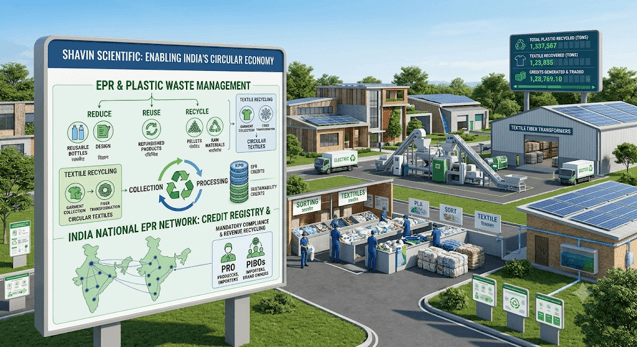
Sustainability Solutions is built for organizations that want to move past disposal language and into engineered circular-recovery systems. The approved PPT material expands this service into alliance-based waste interception, supply-chain transformation, and closed-loop manufacturing support.
Shavin Scientific frames the work around global waste-stream collaborations, post-industrial and post-consumer recovery, take-back systems, automated fabric sorting, chemical breakdown, yarn re-spinning, water conservation, and support for clients pursuing net-zero milestones.
Key capabilities
- Circular economy strategy and waste-stream upcycling tied to real industrial recovery pathways
- Recycle and Renovate programs that intercept discarded materials and convert them into renewed raw-value streams
- Closed-loop textile and garment recycling with take-back systems and cotton-polyester recovery workflows
- Automated sorting using near-infrared optical sensors for fiber classification
- Chemical breakdown, dye stripping, and polyester recovery into raw monomers
- Yarn re-spinning and circular manufacturing support for new commercial output streams
Proof points and positioning highlights
From waste to renewable industrial capital
The service is positioned around turning discarded material into new-value feedstock rather than treating sustainability as reporting alone.
Alliance-led execution
Approved PPT content highlights collaboration with multinational programs and take-back ecosystems where circularity must work across supply chains.
Closed-loop textile depth
The sustainability division includes practical processes for sorting, chemical renovation, polymer recovery, and yarn re-spinning rather than only high-level strategy claims.
Key proof points
15K+
metric tons diverted
Approved PPT benchmark used as provided without adding unsupported figures.
NIR
optical sorting capability for fiber classification
Closed-Loop
manufacturing and material-recovery positioning
Net-Zero
milestone-support framing for partner programs
Sector applications
Apparel and textile programs shifting post-consumer and post-industrial waste away from landfill
Multinational and corporate circularity initiatives needing take-back systems and recovery partners
Industrial operators seeking lower waste, lower incineration burden, and stronger material recovery economics
Sustainability leaders building practical programs around diversion, water conservation, and carbon-transition goals
Circular transformation and implementation model
- Diagnose waste streams, current partner networks, and the material categories with the highest recovery value.
- Design take-back, sorting, breakdown, and remanufacturing workflows that fit the client's real supply-chain environment.
- Stand up recovery operations spanning classification, chemical renovation, polymer recovery, and circular output planning.
- Track diversion, water-conservation, and net-zero-support outcomes in a way that supports operational decision-making.
Technical and operational advantages
- Treats sustainability as engineered transformation, not only policy narrative or reporting language.
- Combines alliance-level thinking with practical recovery methods such as NIR sorting and chemical renovation.
- Links landfill diversion and reduced incineration positioning to closed-loop manufacturing opportunities.
- Supports global partners seeking more credible circularity milestones without inventing unsupported impact numbers.
Technical and operational advantages
- Treats sustainability as engineered transformation, not only policy narrative or reporting language.
- Combines alliance-level thinking with practical recovery methods such as NIR sorting and chemical renovation.
- Links landfill diversion and reduced incineration positioning to closed-loop manufacturing opportunities.
- Supports global partners seeking more credible circularity milestones without inventing unsupported impact numbers.
Why Shavin Scientific
- Brings together waste-stream strategy, technical process design, and supply-chain collaboration in one service frame.
- Uses the approved PPT's circular-fashion and material-renovation detail to make sustainability more concrete and operational.
- Helps clients move toward circular recovery systems with clearer language around material value, not just disposal reduction.
Related solutions
Build the right adjacent capability stack
Explore related services and product pathways that naturally extend this engagement into secure deployment, operational modernization, compliance readiness, or sector-specific implementation.
Next step
Build circular recovery systems that create measurable environmental value
Partner with Shavin Scientific to transform waste streams into structured recovery programs that support circular manufacturing, resource efficiency, and net-zero progress.